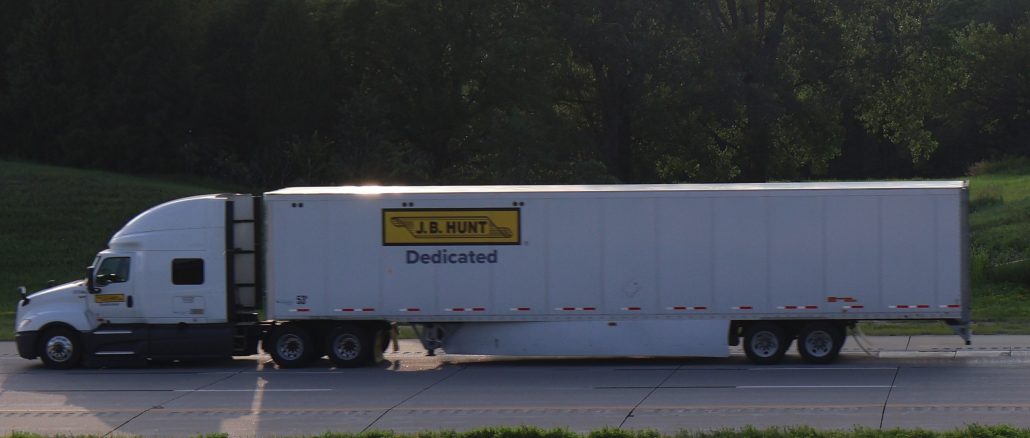
J.B. Hunt Transport Services, Inc. closed out 2025 with a strong finish on profitability and earnings growth, demonstrating disciplined cost management and operational execution despite a soft freight environment. While revenues declined modestly for both the fourth quarter and the full year, improvements in operating income, margins, and earnings per share underscored the company’s ability to generate value in a challenging market.
For the fourth quarter ended December 31, 2025, J.B. Hunt reported on their January 15th investor call that total operating revenue was $3.10 billion, a 2% decline compared to the same period in 2024. Full-year revenue totaled $12.00 billion, down 1% year over year. However, operating income and earnings growth significantly outpaced revenue trends, reflecting structural cost reductions, improved productivity, and continued focus on efficiency across the organization.
Fourth-quarter operating income rose 19% to $246.5 million, while diluted earnings per share increased 24% to $1.90, up from $1.53 in the prior-year quarter. For the full year, operating income increased 4% to $865.1 million, and diluted EPS climbed 10% to $6.12 compared to $5.56 in 2024.
President and CEO Shelley Simpson credited the results to execution and operational discipline. She emphasized that the company achieved its third consecutive record year in safety while continuing to improve financial performance and long-term shareholder value.
Revenue Trends and Cost Discipline
The modest revenue decline during the fourth quarter was primarily driven by lower revenue per load in Intermodal and Truckload, reduced load volumes in Integrated Capacity Solutions (ICS) and Intermodal, and a slight decline in average trucks within Dedicated Contract Services (DCS). These headwinds were partially offset by higher truckload volumes, improved productivity in Dedicated operations, and stronger revenue per load in ICS.
Despite softer demand in certain areas, J.B. Hunt’s cost-reduction initiatives played a significant role in improving profitability. Operating income growth was aided by lower personnel-related expenses, improved network efficiency, and productivity gains across the enterprise. Operating margins expanded year over year, though higher equipment-related expenses and fuel costs partially offset those improvements.
Net interest expense declined during the quarter due to a lower average interest rate, despite a higher average debt balance. The company reported an effective tax rate of 22.4% for the fourth quarter and 24.7% for the full year, in line with historical levels. J.B. Hunt expects its 2026 effective tax rate to range between 24% and 25%.
Segment Performance Highlights
Intermodal (JBI)
Intermodal remained the company’s largest segment, generating $1.55 billion in fourth-quarter revenue, down 3% year over year. Load volumes declined 2%, with transcontinental shipments down 6% while eastern network loads increased 5%. Sequentially, intermodal volumes improved 2% from the third quarter, reflecting seasonally strong demand and improved balance across the network.
Operating income for the segment increased 16% to $135.5 million, driven by better network balance, fewer empty container moves, and efficiency improvements in the drayage network. Lower container storage expenses and improved pricing and productivity from third-party drayage providers also contributed to margin expansion. J.B. Hunt’s continued focus on cost-to-serve initiatives helped offset lower revenue per load.
Dedicated Contract Services (DCS)
Dedicated revenue increased 1% to $843 million in the fourth quarter. Productivity improved 1% year over year, while the average truck count declined slightly. Customer retention remained strong at approximately 94%, underscoring the stability of the dedicated model.
Operating income rose 9% to $98.4 million, benefiting from higher productivity, lower insurance claims expense, and the maturation of new business onboarded over the past year. Increased equipment-related costs partially offset these gains.
Integrated Capacity Solutions (ICS)
ICS posted fourth-quarter revenue of $305 million, down 1% from the prior year. Load volumes declined 7%, but revenue per load increased 6% due to stronger contractual and transactional pricing. Contractual freight accounted for roughly two-thirds of both total volume and revenue.
The segment reported an operating loss of $3.3 million, a significant improvement from a $21.8 million loss in the fourth quarter of 2024. The prior-year period included $16.0 million in pre-tax intangible asset impairment charges. Excluding those charges, performance improved due to lower personnel costs, reduced facility and equipment rental expenses, and lower bad debt expense. These improvements were partially offset by higher purchased transportation costs and compressed margins as market capacity tightened late in the year.
Final Mile Services (FMS)
Final Mile revenue declined 10% to $206 million in the fourth quarter, reflecting softer demand across several end markets and a shift in business mix between asset-based and asset-light services. Operating income fell 43% to $7.5 million, driven by lower revenue and higher equipment-related costs. Cost-reduction efforts helped partially mitigate the decline.
Truckload (JBT)
Truckload revenue increased 10% to $200 million in the fourth quarter, supported by a 15% increase in load volume. Revenue per load declined modestly, but improved trailer utilization and higher trailer turns helped drive growth. Average effective trailer count increased slightly year over year.
Operating income decreased 2% to $8.4 million, as tighter market conditions led to higher purchased transportation, insurance, and equipment costs. J.B. Hunt’s 360box® service saw an 11% increase in volume, reflecting continued expansion of the company’s digital freight capabilities through the J.B. Hunt 360°® platform.
Capital Allocation and Financial Position
At year-end 2025, J.B. Hunt reported total debt of $1.47 billion, slightly below year-end 2024 levels and down significantly from the third quarter. Net capital expenditures totaled approximately $575 million for the year, reflecting disciplined investment levels compared to 2024.
The company remained active in returning capital to shareholders, repurchasing approximately 6.3 million shares for $923 million during 2025. At year-end, J.B. Hunt had $968 million remaining under its share repurchase authorization, with shares outstanding totaling approximately 94.6 million.
Outlook 2026
While freight markets remain uneven, J.B. Hunt enters 2026 with momentum built on operational efficiency, network optimization, and disciplined capital deployment. The company’s diversified business model, combined with continued investment in technology and safety, positions it to navigate market cycles while delivering long-term value to customers and shareholders alike.